While Americans are hitting the back-to-school sales at a
fever pitch, students across Germany will return to hit the books sometime
between the beginning of August and the beginning of September.
The first day of school for former kindergartners
in Germany is a cause for celebration, a ceremony, and gifts.
Sarah Reader, Beaverton native and current
resident of Mittweida, Germany, tells us more.
German children gear up for their first day of school for
almost a year, during which time they have preschool lessons in
kindergarten. Kindergarten in Germany is
not compulsory and could be considered a blend of daycare and preschool rather than
the first year of school as it is in the United States. German children can attend kindergarten
between the ages of 3 and 6. The
preschool year of kindergarten for the five year olds includes weekly
school-like lessons, during which the children work on projects; learn about
letters, numbers, and words; and go on excursions. Near the end of the year the children also
visit the nearby elementary schools which they will attend in the approaching
school year. They meet their teachers,
see their classrooms, and even sit at real school desks for the first time, all
the while becoming more and more excited about the next phase of their
lives: school.
But German children don’t just get on the big yellow bus on
the first day of school and ride to their elementary school: in fact, there are
no big yellow school buses. The first
day of school for the incoming first grade class isn’t even on a Monday, but
rather a Saturday! Saturday school may
sound depressing, or even like a punishment, but it’s a cause of great
excitement for Germany’s six year olds and their families. Each new first grade class at the local
elementary school has a time slot on the Saturday before the new school year
begins. Families and their new first
graders file into the school auditorium; are treated to a skit by older
students who will be entering second, third, and fourth grades; and listen to a
speech by the principal. The new first
graders even bring their backpacks to school and after the show they accompany
their new teacher to their classroom.
There, a symbolic class period is held.
When the ceremony finishes, the families and children are reunited, and
the children then receive their “Zuckertüten.”
Literally translated, the Zuckertüte is a sugar bag; it’s actually a
cone-shaped cardboard package bursting at the seams with sweets and school
supplies and is usually topped with a new toy or stuffed animal for the new
pupil. It is presented to the children
individually by their new teacher at the end of their symbolic first day of
school. Another name for it is
“Schultüte,” or school bag. This name is
used in the western states of Germany, but this school bag is only used on the very
first day of first grade!
 |
| My own son Wilhelm with his Zuckertüte. |
|
|
|
|
The history of the Zuckertüte is rich and varied.
It cannot be summed up briefly as I was told
by collector and expert Hans-Günter Löwe.
He is a retired schoolteacher from Hamburg, Germany, and has collected
Zuckertüten for over 30 years.
He has even
written a book on the subject, which is only available in German:
Schulanfang
– Ein Beitrag zur Geschichte der Schultüte (
Starting School: The History of
the Schultüte).
He says the
tradition has been traced all the way back to 1817 in the city of Jena in the
eastern German state of Thuringia.
According to the Jena City Museum, at that time some children received a
small paper cone filled with cookies on the first day of school.
They were either given the cone or they
picked it from a tree.
The tradition
spread to the other big cities in the states of Thuringia and Saxony and also
to nearby regions such as Silesia and Bohemia—today parts of Poland and the
Czech Republic.
By 1910 the first day of
school treats were also being presented to children in the western regions of
Germany.
For a long time only rich
children received gifts and treats on the first day of school in the festive
packaging.
Children from poor families
considered it a gift to even be allowed to go to school, rather than having to
work in factories or on farms.
 |
| All of the Zuckertüten for the incoming class. |
But in the eastern states of Germany, simply receiving the
Zuckertüte is not the only highlight for children leaving kindergarten and
entering their first year of formal schooling.
There is also usually a celebration for the children who are nearing the
end of preschool, a kind of coming-of-age party when they leave the playful
times of kindergarten behind and enter the world of formal schooling.
This celebration, called the Zuckertütenfest,
could be compared to a kindergarten graduation in the United States. It
marks a significant milestone in the children’s lives: a shift from learning
through play to more serious learning.
The difference, however, lies in the form of the celebration.
While a kindergarten graduation is similar to
a high school or university graduation ceremony, with caps and gowns and a reception
for the young learners, the Zuckertütenfest in Germany is a showcase of what the
young scholars have learned.
The
celebration seems to be especially widespread in the German states of Saxony
and Thuringia.
The Zuckertütenfest may include
a performance like a concert or play, or it may entail an event such as a
treasure hunt during which the children solve tasks that incorporate what they
have learned during their preschool year.
Volker Voigt of Leipzig, Germany, told me that the children leaving the
kindergarten which his children attend hold a performance each year before the
new school year begins.
The children
sing and perform skits about kindergarten and school for their families.
An important aspect of the event is the
Zuckertütenbaum, the tree upon which the cone-shaped treat bags “grow.”
Often, like at Kindergarten
cocolores in Dresden, the children go
for a walk as part of the end-of-year celebration, and upon their return, the
treat cones have magically appeared on a tree in the kindergarten’s yard.
Sometimes the children have even gone to
great lengths in hopes of growing big treat bags and watered their selected
Zuckertütenbaum with sugar water.
Anke
Poppitz of Mittweida, Germany, reports having made small cones out of paper as
a child with her preschool group and hanging them on a tree outside of her
kindergarten.
After hanging the cones on
the tree, they watered it and were even allowed to take their afternoon nap
under the Zuckertütenbaum.
Later the
children went on an excursion, and when they returned, larger treat bags had appeared!
The most involved Zuckertütenfest I have heard of takes
place at Kindergarten
Goethehain in Mittweida, Germany, and I was lucky enough
to accompany this year’s preschool group on their Zuckertütenfest excursion
this year.
The excitement starts several
weeks before the actual celebration, when the children choose a tree on the
kindergarten playground to water with sugar water, dreaming of big
Zucktertüten.
Every day the preschoolers
check the tree, until one day, blossoms appear!
 |
| One of the first blossoms on the Zuckertütenbaum. |
 |
| The first tiny Zuckertüten appear. |
 |
| One week later, they've grown in size. |
A few days after the blossoms
appear on the Zuckertütenbaum, tiny conic treat bags appear in their place
overnight.
The children continue
watering the tree by day, and as the Zuckertütenfest approaches, the treat
cones increase in size.
Finally, on the day of the big
event, the children arrive at the kindergarten in the morning, have breakfast
together, and then they check the tree.
The Zuckertüten have disappeared, and a bag with a letter and a treasure
map is all that’s left.
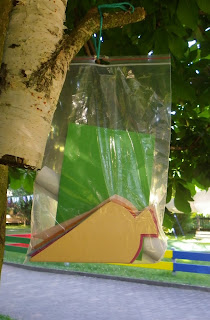 |
| A treasure map was left in place of the stolen Zuckertüten. |
|
This is a tradition that has
evolved over the years at Kindergarten Goethehain:
the children’s treat bags are stolen each
year by a character from a children’s book, and the children have to act as
detectives, following the clues on a treasure map to solve some puzzles in
order to find the treat bags.
This year
a fox named Karl-August stole the Zuckertüten.
The preschoolers know him from a book.
As a fox of course he’s quite sly, and they like him because he loves to
eat Nutella, that delicious European chocolate-hazelnut cream that the kids
also enjoy.
Clearly he wants whatever is
inside those Zuckertüten, too!
The hunt begins: Karl-August left the children a letter and a
treasure map, now it’s time for the preschoolers to put the things they learned
over the past year to the test and see if they can solve the tasks presented
along the way in order to ultimately recover the stolen Zuckertüten. First, the map is examined and the kids check
if they recognize any of the places that the sly fox has sketched out for
them. There are several stations
throughout the town and into the nearby countryside, all places the children
have visited before and recognize on the map.
The group starts at the kindergarten at 8:30 in the morning and embarks
on an all-day hike. The children check
the map to find the first station on their hunt, which is the bus station near
downtown Mittweida. There, each child
has to complete the first task of the day:
saying their name, address, birthday, and age. When that step is complete, the next stop on
the hunt is deciphered from the treasure map and we head on our way.
The second stop, an event center
with a large public garden in an old farm ensemble on the edge of town, is
quite exciting: we find tracks in the
sand! Could they be Karl-August’s
tracks? Again, the children have tasks
to complete. At the farm they have to
name insects and flowers that they have learned about. From here we head into the forest on the
edge of town and to a small stream, where the children need to fold origami
boats and float them on the stream.
 |
| The children are searching for their missing Zuckertüten. |
After this, the group heads toward the Zschopau River.
Along
the way we happen across the old fox farm, where foxes used to be bred for fur;
today the former farm is in private ownership and a family lives there.
We learn here that Karl-August, that tricky
fox, was actually born here and escaped.
The children’s next job is to name trees that they can find in the
forest.
The path continues into the
woods, where we walk past some beautiful cliffs and then into the
Zschopau River valley, building a small bridge along the way and naming animals who live in
the forest habitat.
The next station is
at a large park and recreation area next to the Zschopau River, where we stop for a
lunch break and some time at the playground.
There the children name all of the fruits and vegetables that they know
and are even treated to ice cream.
After
listening to a story about a fox, the group continues to the ferry, which takes
us from Lauenhain on the edge of Mittweida back closer to the city center,
where we finally hike back through the forest and ultimately back to the kindergarten.
The group arrived back at the
kindergarten at shortly after 3:00 pm, without the lost Zuckertüten!
The preschoolers' families had arrived at the
kindergarten by this time, and had set up drinks and snacks at the outdoor
picnic tables, where the exhausted children (and teachers!) could take a break
in the shade.
Then, while everyone was
resting, we heard a siren.
It came
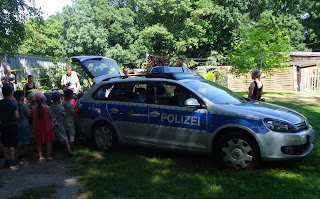
closer, and finally the police pulled into the back gate of the
kindergarten!
The children ran over to
the police car, sure that the police must have arrested that sly fox Karl-August,
and they had!
The police had even
recovered the Zuckertüten: there
was one for every preschooler.
 |
| The police had arrested the fox and recovered the stolen Zuckertüten! |
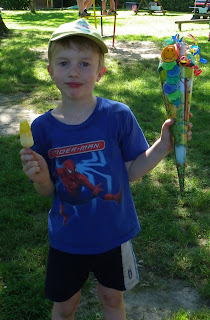 |
| Here is one happy preschooler! |
As you can see, the
Zuckertütenfest and the first day of school are very special coming-of-age
celebrations which mark the end of the early childhood years and the start of a
new and exciting phase of education for children in Germany.
 Here's the map of our last tour. I started tracking a bit late, that's why the loop isn't closed.